
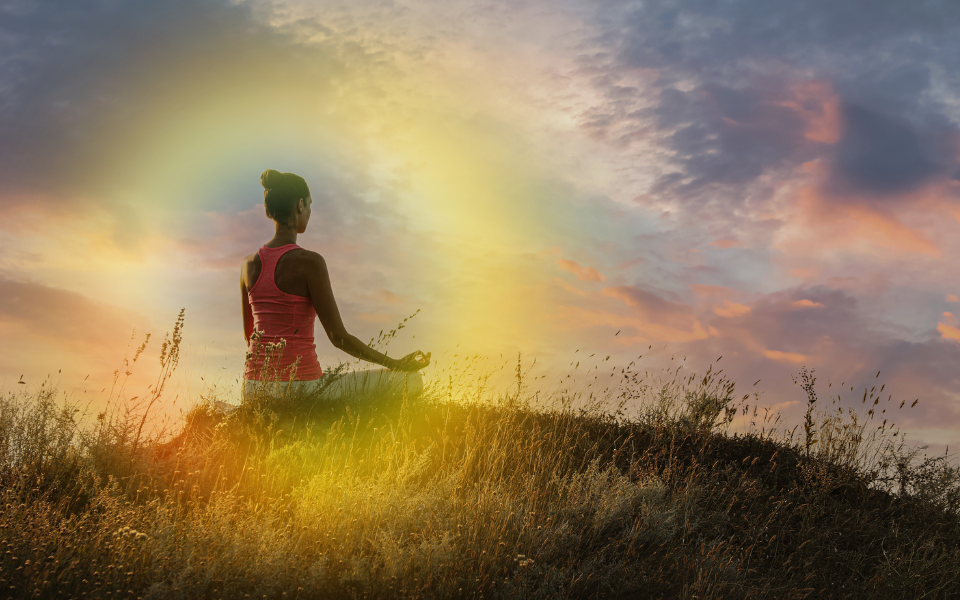
We are living in a world where increasing numbers of people of all ages are suffering with chronic health issues, anxiety, depression, and a deep sense of feeling lost, lonely and disconnected from themselves, others and life itself.
With all the advances in science, research, treatment options and well-meaning professionals, we would hope that we are moving towards greater health and well-being. And yet something is not adding up.
For over a decade, I have had people coming to me to learn meditation, mindfulness and related practices. They arrive for different reasons: to sleep better, to manage anxiety, to find their voice again, to deal with depression, to quiet a mind that won’t stop, to find themselves again after years of losing themselves in their roles. They come looking for one thing, and something much larger begins to happen.
I have watched people whose chronic health symptoms slowly ease. Relationships that felt stuck begin to shift. A lost voice begins to return. The fog of depression begins to lift. Creative energy that had been dormant reawakens. And I began asking myself: what is it that these inner practices are actually doing that creates such wide-ranging change across so many different struggles?
The answer I kept arriving at was this: the practices create inner alignment. They bring body, heart, mind and soul back into relationship with each other. And when that inner alignment begins to grow, something that had been fragmented begins to move toward wholeness. And wholeness, I have come to understand, is what healing actually is.
Wholeness and Healing: Two Sides of the Same Coin
Another word for wholeness is healing. The word healing comes from the Old English hælan, meaning to make whole. As we move toward greater wholeness, we move toward healing. What we often call a disease or disorder can be seen as an invitation to return to wholeness. Our symptoms are not the enemy. They are the soul’s way of getting our attention and a call to come home.
If wholeness is the destination, it helps to understand its opposite. The opposite of wholeness is fragmentation, disconnection and self-abandonment. Wholeness is not the absence of pain or struggle. It is the reintegration of what has been divided.
When I speak of wholeness, I mean the process of bringing our body, mind, heart and soul into harmony and inner alignment. It asks that we integrate our past experiences and the parts of ourselves we had to leave behind to fit into families and cultures that expected certain things from us. Hidden beneath that conditioning is our soul that contains the blueprint for the person we were born to become before the world taught us who we were supposed to be.
This understanding of healing and wholeness is a life orientation that has guided me for the three decades I worked as a nurse, and it continues to guide me now.
Florence Nightingale once said that the role of the nurse is not to heal, but to put the person in the best possible condition for nature to act. I have never forgotten that. It is what I understood nursing to be at its best, and it is what I understand this work to be, too. When I share meditation and mindfulness with others, I am not fixing or healing anyone. I am giving people the tools to cultivate the inner conditions from which their own growth and healing can emerge. Nature does the rest. It always has.
The Crisis We’re Living Through
I believe we are living through a collective crisis of fragmentation and disconnection — and wholeness is the medicine we need.
When the majority of illnesses are stress-related, we are facing something deeper than individual struggles. We are witnessing a profound loss of relationship with ourselves and with what makes us human.
This crisis of fragmentation shows up differently for each of us. You might be a caregiver who has lost yourself in caring for others. A professional who has built a successful life but feels empty inside. Someone navigating a major transition — midlife, loss or awakening — sensing that the old maps no longer work. Or perhaps you are simply exhausted from the relentless self-improvement, the feeling that no matter what you achieve, something essential is still missing.
This fragmentation is not a personal failing. It is the water we are swimming in. And it is making us sick — body, mind, heart and soul.
Our healthcare systems speak of the mind-body connection, but still treat people in parts. Our workplaces demand productivity while depleting our spirits. Our digital lives fragment our attention into a thousand competing directions. We are told to optimize our performance, manage our time and fix our flaws — all while the deeper question goes unasked: how do we become whole again?
There was a season in my own life when stress accumulated until it overwhelmed my system and got stuck. Over time, I began to collect diagnoses — one from a neurologist, another from my family physician, another from my chiropractor. It felt like I needed a spreadsheet to track them all. Yet somewhere inside, I knew these symptoms were messengers rather than mere labels.
I sensed that my task was to find the root cause, because no one else seemed trained to look through the lens of deep healing, the lens of wholeness.
Over time, I began to see that my body’s symptoms were connected to the emotional exhaustion of caring for my aging parents. My nervous system had become dysregulated, and the communication between my body and brain was disrupted. My symptoms showed me how deeply intertwined my emotional, physical and spiritual health were.
The Journey Home to Ourselves
The first step in my return home to myself was self-regulation — learning how to bring calm and coherence back to my body and mind. This became the first of what I now call the 4 Keys to Inner Peace.
Regulating the nervous system is not just about managing stress. It is about creating the inner safety and stability needed for body, mind, heart and soul to come back into conversation with each other. As I practiced, my symptoms slowly eased. Even now, when they surface, they remind me that wholeness is a process that we return to again and again, not a destination.
Wholeness asks us to integrate all parts of ourselves, including the masculine and feminine energies of doing and being, our personality and our soul, the dark and the light. It is a dual movement: remembering the authentic self we left behind and discovering the self that is waiting to emerge. Integration and actualization, past and future, held together in presence. When I discovered the Enneagram of personality, I realized that it was a map giving us a path towards the wholeness so many of us are hungry for.
When we return to wholeness, something profound becomes possible. We stop trying to fix ourselves and start discovering who we are beyond our conditioning. We access deeper reserves of energy, clarity and peace. Our relationships become more authentic. Our purpose comes into focus. We feel genuinely alive, not because life becomes perfect but because we are finally present for all of it.
When we come home to ourselves, we come home to the whole, and that’s when we begin to heal and not only survive, but fully thrive.
And that journey home begins with a single turning — away from fixing yourself and toward finding yourself. If that resonates, I’d invite you to read You Don’t Need to Fix Yourself. You Need to Find Yourself — because finding yourself is where the journey to healing and wholeness begins.
Reflection:
What part of you is asking to be healed and welcomed back into wholeness today?


Leave A Comment