The Science and Soul Behind the Map Home to Yourself
Over the years, people have often asked me where the Four Keys to Inner Peace came from.
The answer isn’t a single book, teacher, or research study. It emerged gradually at the intersection of thirty years of nursing, my own inner journey, a decade of meditation practice, and the wisdom of many researchers, teachers, and contemplative traditions.
As my understanding deepened, I began noticing something remarkable. Although every person’s story was unique, people often arrived at the inner journey through different doorways. Some were overwhelmed by chronic stress or burnout. Others wanted to understand patterns they couldn’t seem to change. Some had lost touch with themselves, while others felt a deeper longing for meaning, purpose, or a life that felt more authentically their own.
Yet beneath these different struggles, I kept seeing a similar movement: from living primarily through stress, conditioning, and habitual personality patterns toward greater awareness, self-understanding, wholeness, and authentic expression.
That realization eventually became the 4 Keys to Inner Peace — Self-Regulation, Self-Love, Self-Discovery, and Self-Expression — a practical map for the inner journey of transformation. The framework brings together meditation and nervous system regulation, self-compassion, Enneagram-informed personality insight, and practices that help us increasingly live from what feels most true within us.
The thinkers, researchers, clinicians, wisdom teachers, and contemplative traditions below have each influenced the way I understand stress, human growth, and transformation. No single source created the Four Keys, but together they have contributed to the science, psychology, and wisdom that underpin my work.
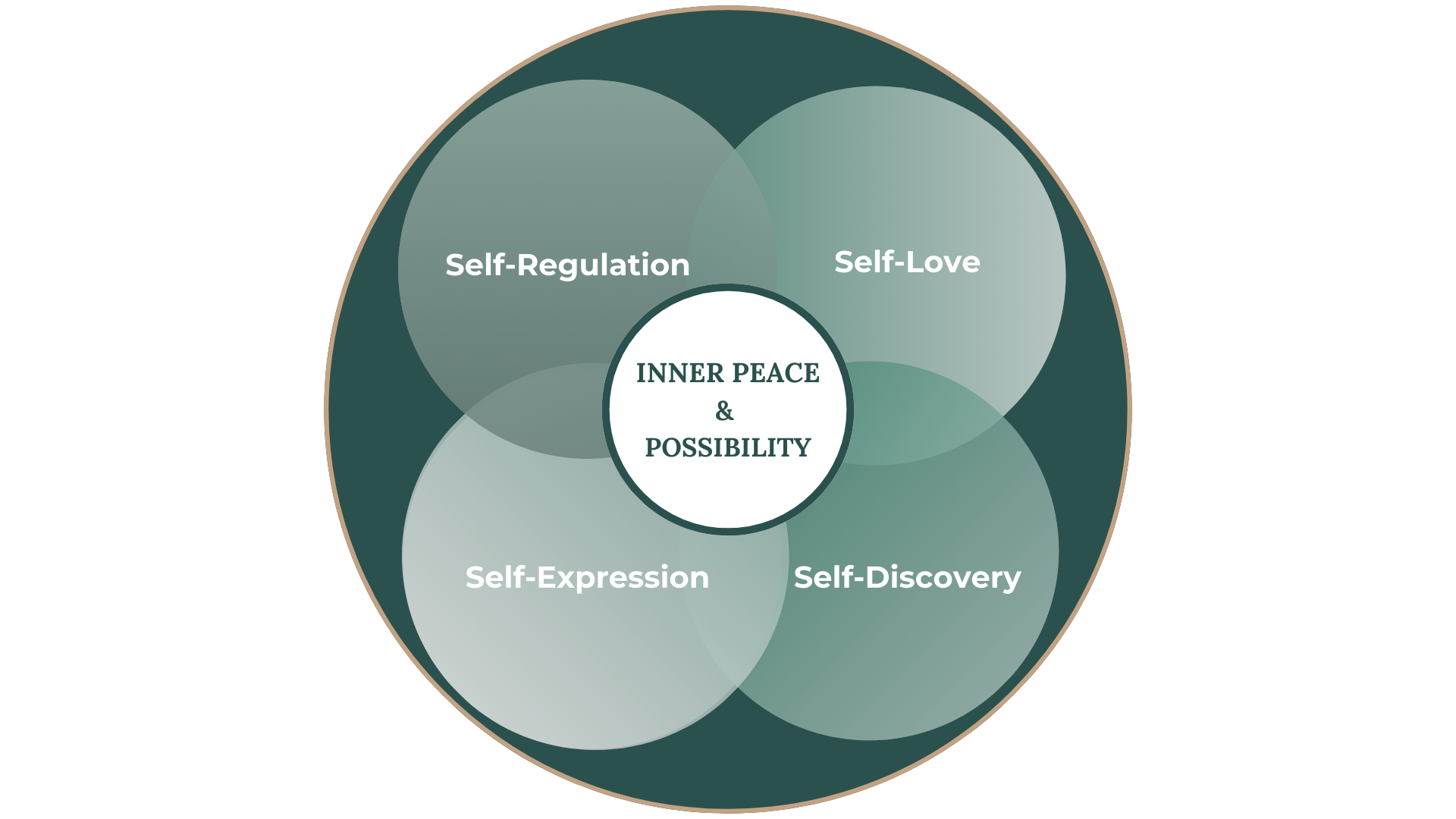
The 4 Keys to Inner Peace:
Self-Regulation – Calm Your Body
These teachings remind us that we can’t always change what’s happening around us — but we can change what’s happening within us. Self-regulation shifts us from survival to presence, restoring the calm clarity that allows life to flow again.
Foundational Wisdom
- HeartMath – As a HeartMath® Certified Mentor, my approach cultivates heart-brain coherence and nervous system regulation.
- Emily & Amelia Nagoski – Research on burnout and the distinction between stressors and stress, and completing the stress cycle in the body.
- Nervous-System and Stress Research – Informed by decades of study in the physiology of stress and resilience, integrating insights from neuroscience, psychology, and mindfulness-based approaches.
- Sarah McLean – I became a certified meditation and mindfulness teacher under the guidance of my contemporary meditation teacher, who established the McLean Meditation Institute. She’s known for the SEED (Simple, Easy, Every Day) meditation approach, which cultivates focus, mindfulness, body awareness, and heart-centred wisdom.
Self-Love – Tend to Your Heart
Self-love begins with learning to create inner safety — the felt sense that we are enough and can be with ourselves without constant striving, criticism, or self-abandonment. As we learn to relate to ourselves with greater compassion and respect, the nervous system softens, our capacity for connection expands, and we begin shifting from self-protection toward self-acceptance and trust.
Foundational Wisdom
- Dr. Kristin Neff & Christopher Germer – Pioneers of mindful self-compassion, teaching both tender and fierce expressions of care.
- Dr. Kelly McGonigal – Research on how compassion and self-kindness build physiological resilience.
- Dr. Rick Hanson – Positive neuroplasticity and “taking in the good” to rewire the brain for safety and worthiness.
- Tara Brach & Jack Kornfield – Practices of mindfulness, loving-kindness, gratitude, and forgiveness that reopen the heart to life.
Self-Discovery – Understand Your Mind
Self-discovery helps us understand the personality patterns and conditioning that have shaped how we learned to navigate the world. These patterns often contain both our greatest gifts and some of our deepest sources of stress and suffering. Through awareness and compassion, we begin loosening our identification with the conditioned self and rediscovering who we are beneath the patterns.
Foundational Wisdom
- Carl Jung – Shadow work, individuation, and the journey toward wholeness.
- The Enneagram (Riso-Hudson, Beatrice Chestnut, & other lineages) – Understanding patterns and pathways to integration.
- Ancient Wisdom Teachings – Buddhist psychology, Esoteric teachings (William Meader), and New Thought.
- Dr. Lisa Miller – Groundbreaking research on the neuroscience of spirituality, demonstrating how an “awakened brain” fosters mental health, resilience, and connection.
Self-Expression – Express Your Soul
Self-expression is the flowering of wholeness. As we become less governed by old patterns and more connected with what feels deeply true, we develop the courage to live, speak, choose, and create from that place. Our inner growth begins to take form in how we live — in our relationships, choices, boundaries, work, creativity, and contribution.
This is what it means to increasingly feel at home within yourself and live from that place.
Foundational Wisdom
- Ken Wilber – Integral approaches to human development and transformation have shaped the way I understand growth as a movement from our current way of being toward a more integrated and expansive way of living.
- Abraham Maslow – His distinction between deficiency needs and growth needs, and his understanding of self-actualization as the human drive to become more fully who we have the potential to be.
- Positive Psychology (Martin Seligman & colleagues) — the science of human flourishing, wellbeing, and what allows people to truly thrive rather than merely cope.
- James Hollis – Creating a life of meaning by asking “What does my soul ask of me?” and having the courage to answer honestly and follow a path that feels good to your soul.
From Wisdom to Practice
The 4 Keys to Inner Peace translate these profound teachings into practical, daily practices. They bridge ancient wisdom and modern science, the needs of our nervous systems and the longings of our souls.
They are not a theory about transformation. They are a practical path for cultivating the inner capacities that make transformation possible: the ability to regulate ourselves, relate to ourselves with compassion, see our patterns clearly, and increasingly live from what feels most true.
Together, the four capacities form a compass for the journey from survival and conditioning toward greater wholeness and authentic self-expression — the journey I think of as coming home to yourself.
If you’d like to understand what walking this path actually looks and feels like, you might find this helpful: The 4 Keys to Inner Peace: A Map for the Journey Home to Yourself.